Adventure! Troop 97
for boys & girls
Fort Collins,
Colorado USA
www.troop97.net
Adventure! Troop 97
for boys & girls
Fort Collins,
Colorado USA
www.troop97.net
 HOME—International Scouting—Scouting Organizations—Scout-like & Scouting Alternative Organizations
There are organizations that don't call themselves Scouts, but might be described as "Scout-like". And there are some groups that call themselves Scouts, but are very different from traditional Scouting. Many (but not all) such organizations consider themselves to be an alternative to Scouting. There is no clear line of distinction between "true" Scouting and "Scout-like" or "Scouting Alternative" programs, nor is there any worldwide agreement on what is "true" Scouting. Here are some guidelines that I use to help determine if an organization is "Scout-like" (and please email me if you can improve on these guidelines, or if you can offer additional information about any of the organizations listed below):
Many of these organizations are US-based, although some have branches around the world. Many are also church-centered Christian evangelizing groups, some belonging to specific denominations, and others available to any "bible-believing, evangelical Christian" church that wants to use the program.
These organizations pre-date Scouting, and hence were doing "Scout-like" activities before there was Scouting. German Scouting owes much to, and has much in common with, the Wandervogel movement. And Scouting founder Baden-Powell thought highly of the Boys Brigade, and counted Boys Brigade founder William Smith as a good friend.
The UK-based Boys Brigade is a forerunner to Scouting, and was founded in Scotland in 1883 by Sir William Smith. Baden-Powell presided over the 1903 annual Boys Brigade display at London's Royal Albert Hall, and became friends with Smith. Today, the Boys Brigade has just over 53 000 youth members, primarily in the UK and Republic of Ireland. The Boys Brigade is Christian-only. Their motto is "Sure and Steadfast", and their object is: "The advancement of Christ's kingdom among Boys and the promotion of habits of Obedience, Reverence, Discipline, Self-respect and all that tends towards a true Christian manliness." For ages 5 through 18, each company is split into four sections: Anchor Section (ages 5-8), Junior Section (ages 8-11), Company Section (ages 11-15), and Seniors (ages 15-18). Their highest award is the Queen's Badge. The separate Girls Brigade was founded in 1893, and exists in over 60 countries. Their motto is "Seek, serve and Follow Christ".

Started in Germany at the beginning of the 20th Century (and pre-dating Baden-Powell's Scouting), the Wandervogel ('migratory bird', representing freedom) movement began among youth and young adults who sought freedom from the strict organization of German society. They hiked, camped, and sang around campfires. Originally male only, the movement became coed later. After World War I, German Scouting was strongly influenced by the practices of the Wandervogel. Banned by the Nazis from 1934 to 1945, some Wandervogel and Scouts became part of the underground resistance against the Nazis. Today, there are perhaps 5000 Wandervogel members in many unrelated associations around Germany.

It's interesting that in the US, those organizations that compete with the Girl Scouts of the USA typically feel that GSUSA is too liberal, and tend to be conservative and often Christian only, while those organizations that compete with Scouting America typically feel that it is too conservative, and tend to be liberal and to stress their inclusivity (though one Christian-only competitor feels that Scouting America has become too liberal). See further below for Christian-only and other strongly religious programs.
Camp Fire is a non-denominational, inclusive, US-only program started almost immediately after the Boy Scouts of America in 1910 (17 March). Its official founders were Charlotte Vetter Gulick and Luther Halsey Gulick, MD. By 1910, Charlotte Gulick had developed a summer camp in Maine she named Camp WoHeLo (Wohelo is still Camp Fire's 'watchword', representing Work Health Love). At the same time in Thetford, Vermont, poet and historian William Chauncy Langdon coined the name 'Camp Fire Girls' for the girls who were participating in a historical pageant he was leading (the local Boy Scouts were also involved in the pageant). Langdon also created three ranks of achievement for the girls: Wood Gatherers, Fire Makers, and Torch Bearers. On 22 March 1911, Dr Gulick chaired a meeting "to consider ways and means of doing for the girls [nationally] what the Boy Scout movement is designed to do for boys." This meeting also selected the name Camp Fire Girls for the organization. Participants included William Langdon, Ernest Thompson Seton's first wife Grace, Dan Beard's sister Lina, and James West (BSA Chief Scout Executive). BSA's Ernest Thompson Seton, Dan Beard, and James West were all members of the Camp Fire Girls Advisory Committee formed that spring. Interestingly, West always regarded the Camp Fire Girls (and not the Girl Scouts) as the girl's equivalent of Boy Scouting.
Originally for girls only, the program has been coed since 1975, when they changed their name to Camp Fire. In 1984, the organization became Camp Fire, Inc.; in 1993, Camp Fire Boys and Girls; in 2001, Camp Fire USA, and in 2012 back to Camp Fire. Youth membership is open to anyone from age 6 weeks to 21, with emphasis on kids aged 5-16. Today, 42% of Camp Fire's youth membership is male, though male participation drops off significantly in the older age range (for example, only about 10% of 2019 recipients of the Wohelo Award were male). Camp Fire's highest award was created in 1962 as the Wohelo Medallion, renamed the Wohelo Award in 1996. Their motto is "Give Service". Membership is 175,000 in 25 states +DC (2021), a 6.4% drop since 2019.


There are several loosely organized groups that promote an earth-friendly lifestyle and use the term 'Earth Scouts':
Earth Champs—Formerly called Earth Scouts, and a subsidiary of Earth Charter US, Earth Champs are "groups of parents and kids, teachers and kids, the community and kids — all working to encourage boys and girls ages 3 and up to become responsible global citizens who know how to 'make a difference' in their local communities and in the world." Using the Earth Charter as a guide, Earth Champs groups "learn about and act to — sustain the environment, achieve economic and social justice, create peace and nonviolence and model participatory democracy".
Kids for Earth—This subsidiary of 'United for Earth' "is an organization dedicated to learn and adopt sustainable lifestyle in modern society." They list their mission as: "To raise awareness and instill proactive approach to understanding the natural resource challenges of modern society." The 'Kids for Earth' scouting program is called 'KE Scouts', for children ages 6 through 18. Through KE Scouts, "kids participate in activities, trips, and awareness/learning sessions that foster earth-friendly ways to leading a sustainable life."
Planet Earth Scouts—This is an "all age global network guided by values/principles systems/structures geared towards our transition to a healthy sustainable future!" They state that: "Earning badges is the number one fun activity for Planet Earth Scouts. Planet Earth Scouts is about learning 'sustainable stewardship' and the 4 Pillars of the Earth Charter provide a framework to develop learning activities that will enable children and adults to learn about values and principles of sustainability. But sustainable living is also about various technologies and practices that are specifically related to food, water, shelter, and energy." "The Planet Earth Scouts family is a community of Earth Stewards who are connected through a common desire to co-create a sustainable and healthy world for future generations. Their individual and collective actions are bringing definition to the term Earth Stewardship and their efforts are weaving a tapestry of planetary healing."
The 4 Pillars of the Earth Charter are:
1. Respect & Care for the Community of Life
2. Ecological Integrity
3. Social & Economic Justice
4. Democracy & Peace

Started in California in 2007, "Frontier Girls is a scout like curriculum for girls offered as an alternative to Girl Scouts for groups to use as part of their youth programming." Girls can work on many hundreds of badges and other awards as they progress through five youth age levels: Penguin (preschool, ages 3-5), Otter (grades K-2, ages 5-8), Dolphin (grades 3-5, ages 8-11), Butterfly (grades 6-8, ages 11-14), and Eagle (grades 9-12, ages 14-18). Adults can also earn badges, and can belong to three more levels: Owl (adult participant, age 18+; "level for girls 18+ and adults who wish to earn badges and awards at the adult level"), Goose (leaders, age 18+), and Starfish (troop helpers, age 18+). The badges are metal pins rather than patches. Troops typically include all age levels, with some activities for all the girls, and others set up for the separate age levels. The Frontier Girl motto is, "If you see a need, Take the lead!" They also have a Promise ("I promise to love God; Be loyal to my country; and to love my neighbor as myself.") and Creed (comparable to the Scout Law). The Frontier Girls uniform is a white shirt, navy blue bottoms (skirt, pants, shorts, blue jeans without holes, etc), and a vest with insignia (red vest for girls, navy blue for leaders, royal blue for Owls). I have not been able to find an annual report or indication of their membership numbers. The national organization licenses their badges, uniforms, and program to individuals or organizations to use.
Frontier Girls also offers an additional, optional, coed (or boys) program called Quest Clubs. According to their website, "Quest Clubs takes all the badges and awards from Frontier Girls and makes them available as an educational incentive program that is open to everyone. There are no membership requirements, no promise to recite, no mandatory uniforms, and no mandatory requirements or policies. You may use Quest to design a scouting style program that suits your own needs and beliefs. While Quest does not require a uniform, we do offer vests in 20 different colors so that you can design a uniform of your choice. Many of our Frontier Girls troops now partner with a Quest Club and meet as a co-ed group."



Officially named the Alberta Junior Forest Warden Association, this Canadian organization has clubs primarily in the province of Alberta, with a few clubs in British Columbia, Saskatchewan, and Newfoundland. They officially began in 1935, and provide an outdoor program of camping, hiking, snow-shoeing, cross-country skiing, canoeing, and wilderness survival, focused on the four key areas of Outdoor Skills, Ecology, Leadership, & Forestry. Open to boys and girls aged 6 through 18, clubs are divided into four levels: Pathfinders (Grades 1-3), Trailblazers (Grades 4-6), Adventurers (Grades 7-9), and Challengers (Grades 10-12). They estimate a membership of about 50 clubs with 1000 'wardens' and 700 adult volunteers and parents. Uniform is a red shirt. AJFWA hosts a 'National Campout' that is somewhat like a Scout jamboree. Interestingly, AJFWA holds a casino license and raises some of their operating funds through casino gambling.
This alternative to traditional Scouting started in 2003 in East Harlem (New York City). Their website states, "Navigators USA is a scouting movement whose mission is community development through youth development. By encouraging the entire family to participate in all activities, we strive to create a multigenerational experience that strengthen families and neighborhoods. Our goal is to move from the "me" generation to the "we" generation using nature as our guide." Navigators has three program sections: Stargazers, ages 4-6; Juniors, ages 7-11, with three age-based levels (Mira, Vega, Polaris); and Seniors, ages 11-18, with four age-based levels (Shadow, Tracker, Pilot, Navigator). They camp, and attempt to address the problem sometimes called nature deficit disorder. Navigators USA is coed, non-religious, and inclusive.
Like the Scouts, they have a Navigator Motto ("Stay on course"), Navigator Slogan ("The more you give the more you get"), law (called Cardinal Points: "Truthful, Respectful, Inclusive, Generous, Dependable, Resourceful, Patient, Cooperative"), and promise (called Moral Compass: "As a Navigator I promise to do my best to create a world free of prejudice and ignorance, to treat people of every race, creed, lifestyle, and ability with dignity and respect, to strengthen my body and improve my mind to reach my full potential, to protect our planet and preserve our freedom."). The organization has colorful handbooks. Their highest award is the Summit Achievement Award.
IFM - SEI (International Falcon Movement — Socialist Educational International)—IFM - SEI "is an international educational movement working to empower children and young people to take an active role in society and fight for their rights." Headquartered in Belgium, they have affiliated organizations throughout the world, especially in Europe and South America [The UK's Woodcraft Folk is an affiliated organization].
Woodcraft Folk—Founded in 1924-25, this UK-based, coed organization appears to be about the sole survivor of a number of Woodcraft organizations started by (or connected with) Ernest Thompson Seton after he was forced out of the Boy Scouts of America in 1915. The Woodcraft Folk regard themselves as "an alternative to the Scouts", and offer a program of "games, drama, discussion, projects, crafts, singing and dancing", along with hostelling and camping activities. They seek to create a world based on "equality, peace, social justice and cooperation." Their five levels are Woodchips (age under 6), Elfins (6-9), Pioneers (10-12), Venturers (13-15), and DFs (District Fellows, over age 15). They have around 25 000 members.
Woodcraft Rangers—This American version started in 1923. They provide "innovative and creative programs for children in the under-served areas of greater Los Angeles." They reach out to over 18,000 at-risk students from over 60 public schools in high-need neighborhoods of Los Angeles county with a year-round program that runs five days a week until 6:00 pm. The program includes a homework clinic, fitness period, and a variety of "engaging activities", including drama, fine arts, dance (from Folklorico to Hip-Hop), team sports, individual fitness activities, and technology-based clubs (photography, robotics, etc.).


If you know of other bona fide Scouting alternatives, please let us know!
We have also stumbled onto a few organizations that appear to be questionable for one reason or another. Some are not registered charities (in the US, they should have IRS 501(c)3 status). Some have very high fees that offer minimal benefits. Most have no clear program offerings, with no handbook or other literature, and often have websites that are long on 'fluff' and generalities, and short on any information about actual programs. If you run into any of these, look for membership numbers, literature and useful/helpful information, 501(c)3 or equivalent charity status, and verify just what you get in return for any fees to headquarters.
These organizations generally do not publish information about their size or finances.
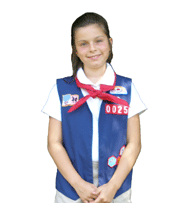
AHG was started in West Chester, Ohio, in 1995, by a group of parents disillusioned with "the increasing secular focus of existing scouting organizations for girls." The organization is US-only, for girls age 5 to 18. AHG calls itself "the premier national scouting organization for young women that embraces Christian values and encourages family involvement" and a "Christ-centered scouting ministry" (adult leaders must be Christians, but girls are not required to be Christians, although they are required to "say the Oath", and are part of an organization whose statement of faith is absolutely Christian). They wear a minimal uniform consisting of a vest or sash, earn badges in five different program levels, and can earn the highest AHG award, the Stars and Stripes Award. AHG has five program levels: Pathfinder (ages 5-6 and in Kindergarten), Tenderheart (ages 6-9 and in grades 1-3), Explorer (ages 9-12 and in grades 4-6), Pioneer (ages 12-14 and in grades 7-8), and Patriot (ages 14-18 and in grades 9-12). Each troop includes all five levels.
The AHG Oath states, "I promise to love God, cherish my family, honor my country and serve in my community." The AHG Creed states, "As an American Heritage Girl, I promise to be: Compassionate, Helpful, Honest, Loyal, Perseverant, Pure, Resourceful, Respectful, Responsible, Reverent."
In 2009, AHG and the Boy Scouts of America adopted a 'Memorandum of Mutual Support' where both organizations agreed "to work with each other to establish a positive relationship and to cooperate in establishing AHG units and BSA units as a result of the shared values and goals of both organizations." AHG dissolved the Memorandum in 2013 when the BSA changed its youth membership policy to end discrimination based on sexual orientation or preference. AHG has 52,000 members in 50 states (2020).

Started in Chicago in 1950, this coed, non-denominational, Christian evangelical ministry has as its goal a "global effort to ensure the opportunity for children and youth to be evangelized and discipled in Christ." It claims Awana groups in 12 000 US churches and 8000 churches in 110 other countries. Awana is an acronym from the first letters of each word in 2 Timothy 2:15, "Approved Workmen Are Not Ashamed". Program levels include Puggles (ages 2-3), Cubbies (preschool), Sparks (grades K-2), Truth & Training (T&T, grades 3-6), Trek (middle school), Journey (high school).

This independent, non-denominational, Christian youth ministry began in 1952. It claims more than 600 "clubs" throughout North America, plus branches or outreach into Australia, Kenya, New Zealand, and Uganda. It is divided into 5 levels, called ministries: Kingdom Kids (ages 4-5, and the only coed level), Junior Cadets (grades 1-3), Recruit-Pathfinder-Builder (R-P-B, grades 4-6), Guide Trails (grades 7-9), and Voyageurs (grades 9-11). The organization has uniforms copied from Scouting, and offers many merit badges.
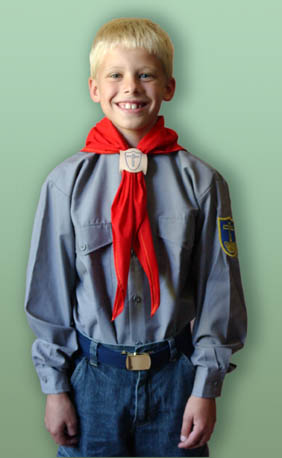
This male-only, non-denominational, Christian evangelical organization was founded by Joe Coughlin in 1937, and has US and Canadian branches. Its Vision is "Godly men who serve, lead and disciple each generation." They wear a uniform copied from Scouting, and are grouped into 4 age levels: Tadpoles (ages 4-5), Tree Climbers (ages 6-7), Stockade (ages 8-11), and Battalion (ages 12-18). Stockade even offers a Pinewood Derby equivalent called the "Shape N Race" derby. The highest honor available to CSB members is Herald of Christ.
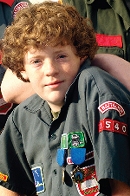

Started in 1925, this is a male-only, Roman Catholic program of the Knights of Columbus for Catholic boys ages 10 to 18. It has over 25 000 young men in more than 1500 local units (called Circles) in North America, the Caribbean, and the Philippines. Boys advance through five levels: Page, Shield Bearer, Swordsman, Lancer, and Squire of the Body of Christ. Their motto is "Esto Dignus" (Latin for "Be Worthy"). The Columbian Squires program strives to provide "the spiritual, cultural, civic, social and physical improvement of its members, and the development of their leadership qualities". "The Squires is designed to develop young men as leaders who understand their Catholic religion, who have a strong commitment to the Church and who are ready, willing and capable of patterning their lives after the Youth Christ."
Founded in 1915, this is a Scout-like program following the principles of the Movimiento Exploradoril Salesiano (MES; Salesian Explorer Movement), based on the teachings of St John Bosco (Don Bosco), the Roman Catholic priest who founded the Salesian movement within the church.

This girls-only Christian youth ministry began in 1958 as the Calvinettes, a girls' branch of the Calvinist Cadet Corps, for girls in grades 1 through 8. They changed their name to GEMS in 1995, and are closely affiliated with both the Calvinist Cadet Corps and the Christian Service Brigade.

This is a coed program of the Seventh Day Adventist Church for grades 5 through 10. One church website indicates that there are 30 000 clubs in 120 countries, which sounds like every Seventh Day Adventist church may have a club. Pathfinders follow a Pledge and Law, earn honor patches, go on campouts and attend camporees, and wear a uniform copied from Scouting. Their motto is "The love of Christ constrains us all". The forerunner Missionary Volunteer Society was founded in 1907; the first camp was held in 1926; and the Pathfinder name was first used in 1929.


This Christian youth ministry began in 1939 as Pioneer Girls, a girls-only offshoot of the Christian Service Brigade. After boys were admitted (originally as Pioneer Boys), the name changed to Pioneer Clubs. The programs cover from age 2 through grade 7.

This is a program of the Southern Baptist Convention, started in 1908, for boys in grades 1-6. Boys in grades 1-3 are called Lads, and boys in grades 4-6 are called Crusaders. There is some camping (RAs can earn 6 campcraft patches: Discover 1/2/3, Hiker, Camper, Woodsman), but the program is designed to develop and train missionaries (ambassadors) for Christ (the Bible verse on their shield begins, "Now then we are ambassadors for Christ..."). The RA Pledge states, "As a Royal Ambassador I will do my best: to become a well-informed, responsible follower of Christ; to have a Christ-like concern for all people; to learn how to carry the message of Christ around the world; to work with others in sharing Christ; and to keep myself clean and healthy in mind and body." The RA equivalent to the Pinewood Derby is called RA Racers. RAs are non-uniformed, but often wear a T-shirt and have a vest on which to wear the badges they have earned. There are RA organizations in 14 countries, also affiliated with the Southern Baptist Convention.
This is a program of the Assemblies of God church, started in 1962, used by many Pentecostal churches. This is probably the most widespread Scout-like program, with headquarters in the US and branches in 63 countries with over 100,000 members. Some German Royal Ranger units call themselves "Christian Royal Ranger Scouting". The Royal Rangers refer to themselves as a "scouting-type" or "Christian scouting" organization, and they wear a uniform copied from Scouting. They deliberately parallel traditional Scouting, using non-traditional terminology, and emphasizing their mission "to reach, teach, and keep boys for Christ". Some equivalent terminology includes: outpost (troop), Ranger Code (Scout Law), Ranger Pledge (Scout Promise), Commander (Scoutmaster), merits (merit badges), Gold Medal of Achievement (Eagle Scout), National Camporama (National Jamboree). Their four program levels are divided by school grade: Ranger Kids (Kindergarten through 2nd Grade), Discovery Rangers (3rd through 5th Grades), Adventure Rangers (6th through 8th Grades), and Expedition Rangers (9th through 12th Grades). The Royal Ranger motto is "Ready".

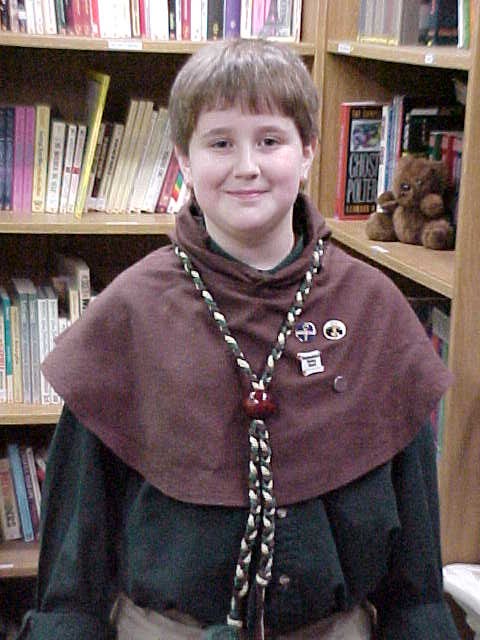
SpiralScouts started in 1999 as a program of the Aquarian Tabernacle Church (in Washington state, US) offering a Scouting-type program for Pagan (Wiccan) families and others of minority beliefs. SpiralScouts International began in 2001, and has groups in the US and Canada, and some in Europe. Membership is inclusive, and open to people of all faiths. Groups are organized into Circles, which can be composed of Hearths for different age groups: RainDrops (ages 3-5), FireFlies (ages 6-9), SpiralScouts (10-13), and PathFinders (14-18). The SpiralScout Oath is, "A SpiralScout shall: Respect all living things; be kind and courteous; be honorable; be mindful of his/her words; seek out knowledge in all forms; recognize the beauty in all of creation; offer assistance to others; value honesty and truth; honor personal commitments; and respect the Divine in all things."

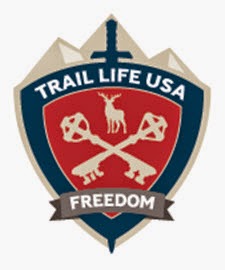
This started in 2013 as a Christian scouting alternative to the Boy Scouts of America, in response to BSA's decision to open membership to gay youth. Ironically, the Trail Life USA youth membership policy allows for the possibility of gay youth joining. Adult leaders must be Christians who subscribe to the Trail Life USA Statement of Christian Faith and Values. Youth do not have to be Christian, but the organization is based on and strongly teaches Christian beliefs (for example, the Trailman's Handbook says, "You were created in the image of a Triune God" and that you need to be "a good citizen of your family and of the body of Christ.") Trail Life USA has three youth levels, for boys only: Woodlands Trail (consisting of Foxes [grades K-1], Hawks [grades 2-3], & Mountain Lions [grades 4-5]), Navigators Program (grades 6-8), and Adventurers Program (grades 9-12); and it offers the Guidon Program (ages 18 through 25, for "Christian young men and women"). A member is called a Trailman. Their motto is "Walk Worthy" (a Bible quote from Colossians 1:10), and their Oath is very similar to that of the BSA ("On my honor I will do my best to serve God and my country; to respect authority; to be a good steward of creation; and to treat others as I want to be treated"). They wear a uniform copied from Scouting. Their highest award is the Freedom Award, whose badge is filled with Christian symbolism ("Trinity Peaks" representing the Holy Trinity; cross-shaped "Sword of the Spirit"; "Shield of Faith" with red color for the blood of Christ and a blue border for the blue sea representing the fellowship of believers; "Mighty Stag" representing the ability to stand strong in faith; "Crossed Keys" representing citizenship in the Kingdom of Heaven and the eternal freedom which Jesus unlocked through the cross; even the word "Freedom" is intended to indicate that "true freedom can only come through Christ Jesus"). Trail Life has roughly 36 000 youth and adult members in all 50 states (2021).


Started in Bloemfontein, South Africa, in 1931, this is an Afrikaans-speaking alternative to traditional Scouting. The Voortrekkers ('pioneers') promote an "ABC" philosophy of Afrikanerskap, Burgerskap, Christenskap (Afrikanership, Citizenship, Christianity). They regard themselves as a cultural organization, desiring to maintain Afrikaner culture and the Afrikaans language. The organization is open to anyone who "feels comfortable in an atmosphere of the Afrikaner culture". Their reluctance to be a part of traditional Scouting is perhaps understandable given that Scouting's founder was most famous for defeating the Afrikaner siege of Mafeking during the 1899-1902 South African War (Anglo-Boer War or Tweede Vryheidsoorlog). The Voortrekker motto is "Hou Koers" ("Hold [or Stay] the Course").

These organizations, while often wearing a Scout-type uniform and doing other Scout-like activities (such as camping), are highly political in nature.
This nationalist organization has aims "to promote the objects, principles and exercises of scouting among the boys and girls of Ireland." Founded in 1909, the organization is highly political and nationalistic, putting primary emphasis on Irish political issues, most centrally the reunification of Ireland (their core tenet is that Ireland should be "a Sovereign, Independent State from the centre to the sea"). The 12-point Fianna Code states that A Fian is patriotic, reliable, diligent, kind, obedient, cheerful, thrifty, brave, clean, humble, temperate, punctual. I have not found any membership data, and the organization has recently undergone a reorganization.

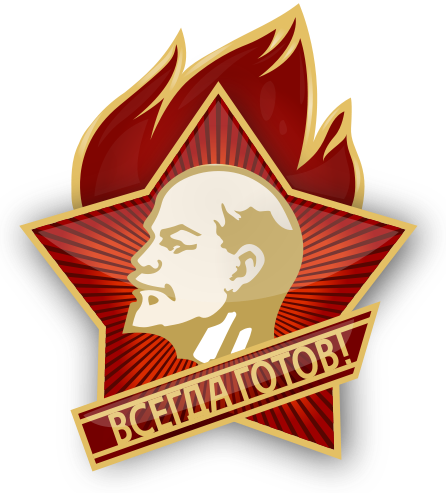
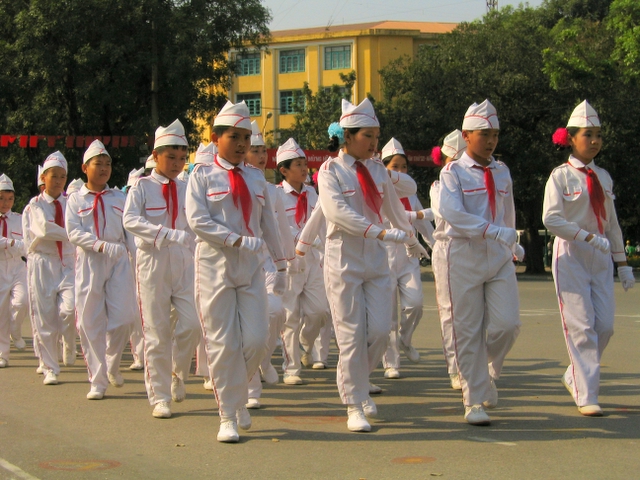
This is the often compulsory, government-run youth organization in most communist countries (started in the former Soviet Union, today there are Young Pioneers in China, Cuba, North Korea, and Vietnam). True Scouting, or any other potentially competitive youth organization, is illegal in these countries. The motto on the Soviet Young Pioneers pin says "Always Ready". I have not found any membership data.


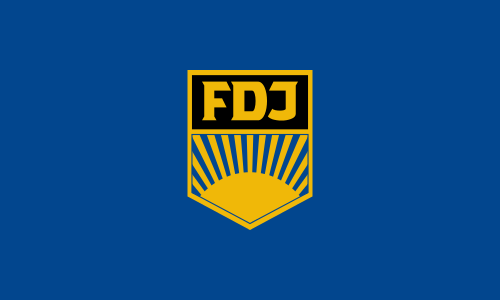
The WFDY was founded in 1945 and is recognized by the United Nations as an international youth non-governmental organization. Started in London, it is currently based in Hungary. Left-wing and communist-oriented youth groups in many countries are affiliated with the WFDY, though it suffered significant membership losses after the collapse of the Soviet Union.


Last Revision to This Page: 13 May 2026
Text copyright © 2002-26 by Troop 97 BSA
Fort Collins, Colorado, USA
Images are either non-copyright or are copyright © their respective organizations