Adventure! Troop 97
for boys & girls
Fort Collins,
Colorado USA
www.troop97.net
Adventure! Troop 97
for boys & girls
Fort Collins,
Colorado USA
www.troop97.net
 HOME—BSA Handbooks & Handbook Covers—Scout Handbook—8th Edition
8th Edition had two covers:
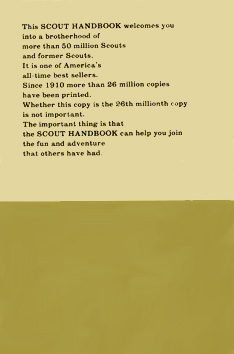
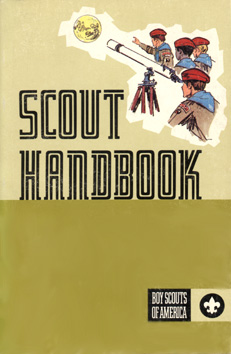
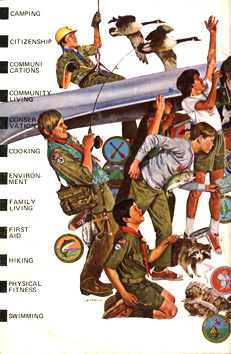
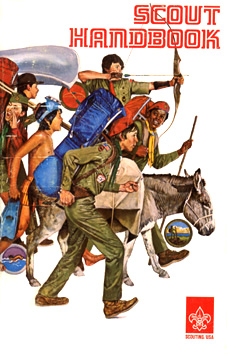
This edition represents the most radical change in Handbook content the BSA ever made. It introduced more new concepts and deleted more traditional subjects than any other edition. The drastic program changes it presented were a disastrous failure for Scouting. From September 1, 1972, through the end of 1977, the "Improved Scouting Program" de-emphasized camping by making outdoor skills optional in the lower three ranks and by eliminating outdoor merit badges from the required list for the higher three ranks (the Eagle list dropped Camping, Cooking, Nature, Swimming, Lifesaving). The new program also extended inner-city programming to ALL of Scouting. (The Handbook's entire section on "Lost" shows a drawing of a boy talking to a policeman, with the text: "Ask for directions to find the way."). The Scouting program represented by this Handbook stands in sharp contrast to Scouting before 1972 or since 1978.
The 8th Edition leaves out a lot of other traditional Handbook information: how to wear a neckerchief, when to wear the uniform, lashings, stars, fire without matches, tracking/trailing, silent signals, semaphore and Morse signaling, edible wild plants, finding directions without a compass.
Until 1972, Scouts working on the first three ranks had to complete a long list of basic skills to earn each rank. The 8th Edition groups the skills into 12 "skill awards" (Camping, Citizenship, Communications, Community Living, Conservation, Cooking, Environment, Family Living, First Aid, Hiking, Physical Fitness, Swimming), each represented by a metal belt loop. These provided "instant recognition" as Scouts worked toward ranks. The BSA discontinued skill awards and returned to the previous system at the end of 1989.

The 8th Edition is the first Scout Handbook to discuss ethnic groups. Non-white Scouts are obviously in evidence throughout the book, not just a few background characters as in the 7th Edition. The discussion of abusable drugs is extensive; earlier editions barely mention them. The Handbook adds sections on general communication (in lieu of signaling), family living, and community living. It contains all the merit badge requirements for the first time in 14 years.
The book finally adds modern conservation emphases long overdue. It de-emphasizes pioneering and advocates modern knife and axe practices; this is the first Handbook not to include information on the destructive and unnecessary practice of tent ditching. This Handbook also adopts the international Scout handclasp as recommended by Baden-Powell (standard handshake with the left hand). Previously, the BSA had used a left handshake with three fingers extended.
This edition contains new wording for the explanatory part of the Scout Law, the first such change since the Law was written more than 60 years before (BSA has continued to slightly alter the explanatory wording with almost every new edition since). The BSA said that this was done to bring the reading level of the material down to the Sixth Grade level (although the wording for Loyal only confuses this point with Trustworthy in a boy's mind: "A Scout is true to his friends,...")
Some 8th Edition printings are printed on cheap recycled paper, which gives those books a drab look in spite of the color artwork. This was the first Handbook bound with a "perfect" binding (like a pad of paper). It is too bad that economics have dictated the change to the "perfect" binding. I still have my first Handbook (a somewhat dog-eared 5th Edition, but the covers and all the pages are there). Few of today's Scouts will be able to carry their first Handbook into adulthood without missing pages, covers, and even entire sections.
8th Edition Summary and Printing History
Actual 8th Edition Table of Contents


Last Revision to This Page: 14 May 2026
Text copyright © 1980, 1990, 1999 by Jeff Snowden
Web format © 1996-2026 by Troop 97 BSA
Fort Collins, Colorado, USA
Handbook images copyright © by Scouting America